
The Best Embroidery Hoops: Types, Sizes, and How to Choose
The Best Hoop for Hand Embroidery
An embroidery hoop is one of the main items on the list of embroidery supplies. You can change the fabric and threads from one project to the next. Of course, you’ll also change needles as you go. But the embroidery hoop, if chosen well, will stay with you, and you’ll use it time and time again.
From Wikipedia: “An embroidery hoop, formerly known as a tambour frame, consists of a pair of concentric circular or elliptical rings. The larger ring has a clamping mechanism. The artisan repositions the hoop as needed when working on a large piece of fabric. They come in various sizes and are generally small enough to be held with one hand and rested on the lap.”
Historically, they were made of wood, bone, metal, or ivory. Modern embroidery hoops have better tension-adjustment mechanisms. In addition, the materials have changed significantly. This blog post will review contemporary embroidery hoops by type, size, and material. It will also give you some tips on how to choose an embroidery hoop that will serve you for years to come.
Why do we use embroidery hoops?

Do we really need to use one? Yes and no. It depends on the embroidery project you’re planning. Some embroidery techniques, such as sashiko or boro, don’t require the use of a hoop. Other techniques, such as cross-stitch, can be done with or without a hoop.
Modern surface embroidery, on the other hand, requires the use of embroidery hoops. And the hoop you use must be of good quality to ensure even and consistent fabric tension as you work on your project. In addition, keeping the fabric taut in an embroidery hoop will help you create neater stitches when embroidering by hand. It can also prevent the spaces between stitches from puckering.
Remember that an embroidery hoop isn’t the only way to keep the fabric taut. There are alternatives, such as Q-snaps, which are very popular among cross-stitchers. You can also use chalkboard frames, parchment frames, or embroidery frames instead of embroidery hoops.
Types of Frames
We can group by:
- Tension type: screw tension, spring tension, or Flexi.
- Material: plastic, wood, or metal rings.
- Size: mini, small, medium, or large diameter.
- Ring Depth
Screw-Tension Rings

I suppose this is the most standard type of embroidery hoop, in which the fabric is tensioned by placing the piece of fabric between two rings. A screw on the outer ring allows you to increase or decrease the tension of the hoop. Screw-tension hoops are available in various materials, sizes, and shapes.
When choosing a screw-tension hoop, pay attention to the hardware. The screw should have external grooves that provide a grip so you can tighten it with your fingers. In addition, a good tension screw has a slot for a screwdriver so you can tighten it securely. It’s best if all the hardware is made of brass. Brass hardware is sturdy and durable, and it won’t bend no matter how tightly you tighten the screw.
Spring-loaded embroidery hoops
With these hoops, tension is created by an inner metal ring that fits into a slot in the outer plastic or metal hoop. These hoops are typically used for machine embroidery. Elastic tension hoops can also be used for hand embroidery and cross-stitch. Minor drawbacks of spring-loaded tension hoops: the handles are bulky and can get in the way; furthermore, the tension of the fabric cannot be adjusted.
Flexible rings
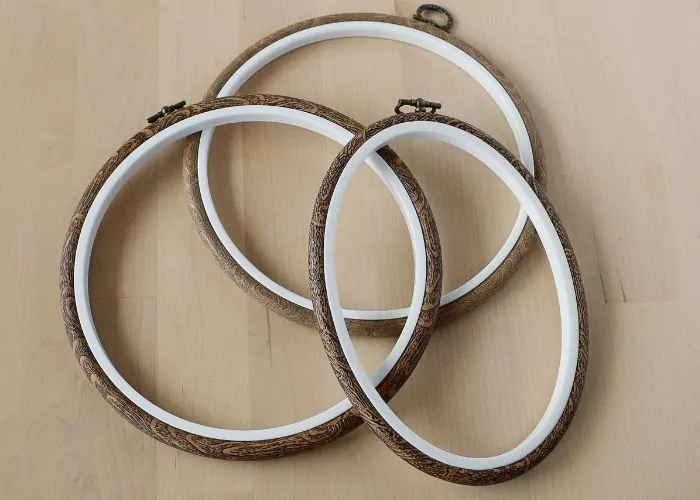
These are made of a rigid plastic inner ring and a flexible outer ring. They’re pleasant to work with and hold the tension quite well, but they can’t be adjusted. This can be a problem if you’re embroidering on a thicker fabric or on a piece of very fine material.
Flexible rings come in a variety of sizes and shapes. You’ll find round, oval, and even square Flexi rings with rounded edges in many sizes.
Plastic rings
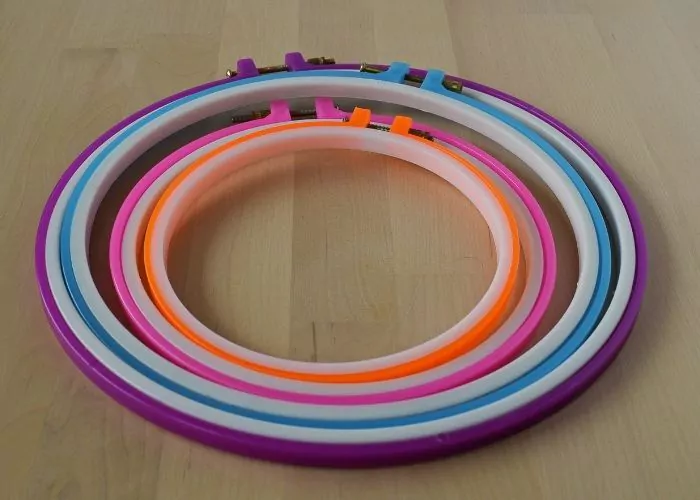
It’s the most affordable option on the market. Some plastic hoops have molded edges that help keep the fabric tauter, but they can also damage it. Some plastic hoops are stiffer, while others are too flexible to hold their shape well. If you want to choose a plastic hoop, opt for higher-quality, stiffer hoops. But generally speaking, I don’t recommend a plastic hoop as your primary work hoop. It can be an excellent alternative for framing your finished piece in a colored plastic hoop.
Plastic rings come in round, oval, and even square shapes, and in many different sizes.
Metal rings
These hoops are relatively rare these days, but there are many vintage metal embroidery hoops on the market. Metal embroidery hoops feature a tension adjustment mechanism that uses a spring or a screw.
Wooden Hoops
The most popular ones are made of wood. An excellent wooden hoop has the following qualities:
- It is made of high-quality wood (usually birch) and is solid and sturdy.
- It can’t be bent easily.
- The outer ring fits very well with the inner ring.
- The hoop has a natural finish and is gently polished.
- There are no splinters that can get caught in the threads or hurt your fingers.
- It features sturdy, durable hardware made entirely of brass for adjusting the tension with a screw.
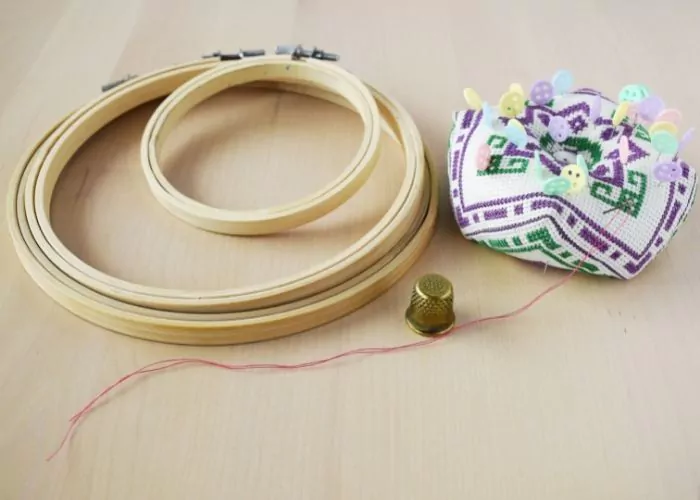
What about bamboo hoops? Bamboo embroidery hoops are an inexpensive alternative to birchwood hoops. However, they aren’t as sturdy and tend to bend. In addition, some bamboo hoops aren’t well-polished and have splinters. But the worst thing about bamboo hoops is that they tend to lose the tension on the fabric while you’re working. I’ve noticed that the rims of bamboo hoops don’t fit together as well and can leave some gaps when you tighten them.
Despite all of the above, I still use bamboo hoops—not for embroidery, but for framing finished embroidery projects. These hoops are inexpensive, come in many sizes, and can be easily dyed or painted with acrylic paint to create the perfect frame for your hoop art.
Embroidery Frame Sizes
Modern hand-embroidery hoops come in all shapes and sizes. From mini hoops (1–2 inches) to the largest 12-inch hoops. The smallest mini hoops are ideal for making embroidered keychains or pendants. The larger ones are perfect for displaying your embroidery.
Medium-sized hoops (15–18 cm) are the most comfortable for sewing. So, if you want one for sewing, choose a high-quality, medium-sized wooden embroidery hoop.
Depth of the embroidery hoops
They come in different depths: from 1 cm to 2.5 cm (0.4–1 inch) deep. Typically, the least expensive bamboo hoops are 1 cm deep, good-quality wooden rings are 1.25–1.75 cm (0.5–0.7 inches) deep, and large padded rings are up to 2.5 cm (1 inch) deep.
Generally, a 1.5-cm (⅝-inch) frame is an excellent choice for most embroidery fabrics. However, heavier fabrics, such as wool or thick linen, may require deeper hoops.
Keep in mind that quilting hoops are not the best choice for hand embroidery, since the edges of the inner hoop are slightly rounded. This allows for the thick layers of a quilt. In contrast, an embroidery frame has straight edges designed to hold a single layer of fabric.
How to Hold the Hoop While Working
Embroider with one hand and hold the hoop with the other. If you want to work faster, consider trying a hoop holder. It holds the hoop for you, allowing you to use both hands to sew.
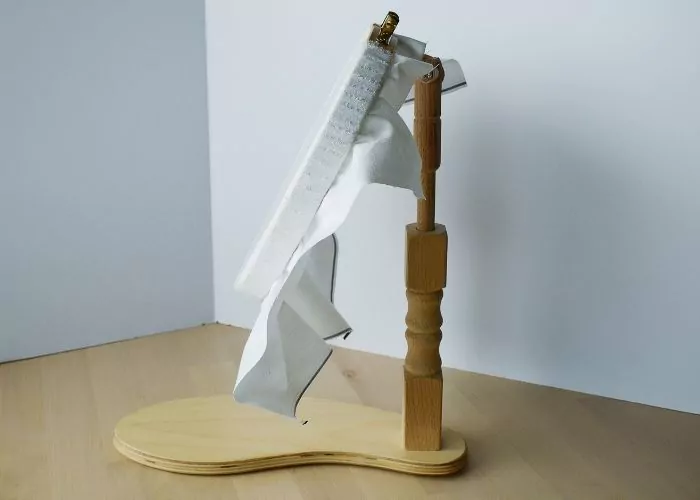
Some options for hoop stands:
- Support
- Desktop Stand
- Floor Stand
- Mounted on the table with a clip-on holder
I use a knee rest, and I love it because it lets me embroider on the couch while watching TV.
Some additional tips
Do not leave the embroidery on the hoop when you are not sewing. Maintaining tension for a long time can cause wrinkles that are difficult to remove. Some more delicate fabrics can even be damaged by prolonged tension in the hoop. Instead, stretch the fabric in a hoop just before you start sewing, and remove it from the hoop for a day after you finish sewing.
If the fabric slips while sewing, wrap the inner hoop with cotton twill tape. This will create additional friction, hold the fabric more securely, and protect it from the floor. In addition, when working with thin, slippery fabrics or larger pieces, wrapping the inner hoop will minimize creases in your fabric and prevent crushed stitches.
It’s best if the embroidery hoop is 2 to 4 cm (1–1.5 inches) larger than the design. This will allow you to embroider the entire design without having to re-center it. If your design is significantly larger, use a 15–18 cm hoop and re-center your work as you embroider. However, a hoop that’s much larger may be too big to hold, and your hands will get tired from controlling it. If your design is large and you don’t want to re-center it in a hoop, look for alternatives such as chalkboard frames.
More about hand embroidery tools and materials:
- My favorite hand embroidery supplies, tools, and materials
- Hand embroidery needles
- Embroidery hoops
- Embroidery floss and threads
- Guide to hand embroidery fabrics
- Scissors for hand embroidery
- Water soluble stabilizers
- Carbon paper for pattern transfer
- Mending tools and materials
- Mini embroidery hoops
- Best hand embroidery books
- Embroidery materials for beginners