

How to Add Texture with Embroidery Knot Stitches: A Guide to 17+ Techniques
If you see a piece of textile art with a textured, raised surface embroidery, you are likely looking at stitches from the knot family. They may look different and have different applications, but one thing is sure: all embroidery knot stitches in the Knot family require some kind of knotting to form the stitch.
In this blog post, we will explore the Knot stitch family and its hand embroidery techniques. I will also link to the step-by-step tutorials, so you can learn the stitches you like and use them in your embroidery practice.
To make this deep dive more structured, I grouped Knot stitches into three categories: isolated stitches, line and band stitches, and filling stitches. Note that this grouping isn’t exact, as some stitches could belong to more than one group. I also added one more group: knotted stitches from other stitch families, where I listed techniques that include a knot but where knotting isn’t the stitch’s main feature.
The core of the Knot family: Isolated knot stitches

Isolated embroidery knot stitches create a single, stand-alone element on the fabric surface. The first isolated knot stitch that comes to your mind is surely the French Knot. But there are more lonely stitches you can use: from Colonial Knot to Bullion Knot, from Danish Knot to Peking Knot, and more.
Bullion Knot


The Bullion Stitch is a remarkably decorative hand embroidery technique from the family of knot stitches and has various application options. In botanical designs, we use Bullion knots to depict flowers, leaves, and berries. Besides that, bullion knots are often a part of composite stitches, border decor, and decorative edging. This dimensional stitch creates an engaging surface if we use this hand embroidery technique for filling.
Colonial Knot


Traditionally, Colonial Knots are used in Candlewicking embroidery – a Whitework technique.Colonial knots work great as decorative stitches in the floral designs – for densely filled centers or single dotted accents.
Just like with French Knots, you can use this technique for textured or powdered fillings or to secure sequins on the fabric. Besides that, you can add Colonial knots into composite stitches or borders.
I address all the differences between these two stitches in the article “French and Colonial Knots Explained: Hand Embroidery Beginner’s Guide” on this Blog.
Danish Knot


This decorative knot features three spokes and a laced center. To make a Danish Knot, you will need to make a straight stitch and add two loops of lacing.
This decorative detached knot will be useful for small details and powdered fillings with texture in decorative surface embroidery.
You can also use this technique for decorative borders.
Four-Legged Knot


This isolated knot stitch looks like a plus sign with a knot in the middle. Four-Legged Knot is a detached decorative stitch that you can use as a standalone element or for powdered filling. The positioning of the knots when filling can vary from evenly spaced knots stitched in lines to randomly positioned Four-Legged Knots turned at different angles.
French Knot


This small knot is the most popular technique in the family. It has many uses – from filling areas and accent stitches to being a part of complex composite stitches as a lattice stitch.
This technique is so popular and often used that I have a couple of deep dives and a stitch along to learn and practice French Knots:
- French Knot Embroidery Stitch: Complete Tutorial, Tips & Troubleshooting Guide
- French Knot Embroidery Sampler: Detailed Step-By-Step Hand Embroidery Tutorial
- Isolated French Knots: Start, Finish, and Trailing Between the Stitches

Peking Knot


The embroidery technique of the Peking Knot allows you to make knots or loops on the surface of the fabric. You can vary the size of the knot or loop by adjusting the loop while stitching.
In traditional Chinese textile art, the Peking Knot is a filling stitch. Rows of same-sized knots, or sometimes loops, embroidered with a silk thread, create a uniform textural filling.
In modern surface embroidery, it is also used as a decorative detached stitch. In botanical designs, you can depict berries or flowers with these knots. Besides that, you can use Blind Knots of various sizes to add dimension and depth to your embroidery design.
Pistil Stitch


It is basically a French Knot with a tail, and you could accidentally make it by placing the stitch incorrectly.
This hand embroidery stitch depicts the central part of the flower, so it is mostly used in floral embroidery. You can also combine this technique with other hand embroidery stitches to create intriguing border designs or composite stitches.
Sienese Stitch


This simple, yet decorative hand embroidery stitch works great as an isolated stitch and for powdered fillings. You can cluster stitches of different sizes, made at various angles, or create repetitive patterns to fill the background of your stitching.
Besides that, Sienese Stitches positioned in rows will create decorative bands and borders. You can adjust the width of the bands and make curvy lines with this technique.
Rows of Sienese Stitch embroidered close together can also work as a dense filling.
Sword Stitch


Two interlocking stitches create a cross shape with four legs, where one leg is longer than the others. This way, the shape looks like a sword.
To make this stitch, you will make a diagonal stitch, then lace one more stitch over the previously made one.
Sword Stitch is an isolated stitch and can be positioned to your liking. The most common uses of this technique are powdered filling and decorative bands for edges and borders.
Creating continuous texture: Knotted line & band stitches

When making isolated knot stitches, you make a single knotted element and move on to the next one. You can surely stitch them close to each other and create lines or bands, but they are still isolated elements. Stitches from this category are different. Knotted lines and bands are the stitches that create a continuous line or band and can not be created as a single, detached stitch.
They come in different styles and sizes and can be used in many different ways – from outlines and lettering to decorative bands on the garments.
Indian Edging Stitch


The main purpose of the Indian Edging Stitch is for embroidering decorative edges and borders on garments. It looks great on collars, cuffs, and for decorating seams. For a more decorative effect, you can combine this technique with beads or sequins to create luxurious embellishments on garments.
Also, Indian Edging Stitch looks great as an individual decorative element – a triangular shape with a laced motif in the middle.
Knotted Diamond Stitch


Knotted Diamond Stitch is a technique for decorative borders and bands; therefore, it is mostly used to decorate home textiles and embellish garments. The line of Knotted Diamond Stitch will look great on the edges and cuffs of shirts and blouses, as a collar decoration, or as a decorative motif on the table runner.
You can embroider Knotted Diamond Stitch bands on straight lines or slightly curved ones, adjusting the spacing between the shapes on both lines. Besides that, you can stitch Knotted Diamond Stitch as a decorative band with angles – just plan ahead that the section of the diamond shape is positioned directly on the angle.
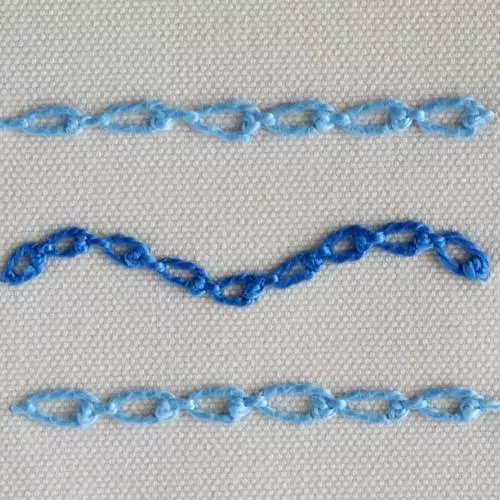
Knotted Loop Stitch


This decorative hand embroidery technique is mostly used to stitch decorative bands. But the possibilities Knotted Loop Stitch offers vary from airy filling to botanical elements like leaves and branches to wavy decorative bands and borders.
Traditionally, the Knotted Loop Stitch is stitched between two parallel straight lines, maintaining a consistent stitch spacing. To mix things up, try changing the density of the stitches, adjusting the distance between the lines, or embroidering it on the curved bands.
Pearl Stitch


The Pearl Stitch hand embroidery technique is a classical decorative outline stitch you can use to outline shapes in your designs. The stitch bends well and follows curves nicely; therefore, it is easy to use in botanical designs, decorative borders, and garment embellishments.
The stitch is decorative, yet flexible; you can use it for lettering.
Adjust the thread size and knot spacing to achieve different visual results.
Scroll Stitch


The Scroll Stitch technique can be applied to straight and curved lines. It is excellent for outlines, lettering, simple borders, and botanical embroidery. Closely embroidered rows of Scroll Stitch will form a textural filling.
Zig Zag Coral Stitch


Zig Zag Coral Stitch is a decorative variation of Coral Stitch. The knots of the Coral stitch are positioned on two parallel lines and spaced in a zig-zag manner to create an ornamental band.
Use this decorative hand embroidery technique to embroider borders, embellish garments and home textiles, couch the ribbon to the fabric, or for crazy quilting. You can also combine this embroidery technique with other stitches to create decorative bands.
Textural filling with embroidery knot stitches

The group of filling stitches from the knot stitch family looks so small because I did not include all embroidery knot stitches we often put in this category. French Knots, Bullion Knots, Colonial Knots, and other stitches from the group of isolated knot stitches are often used for filling.
But there are also these stitches that were born for filling only:
Spiral Trellis Stitch


Spiral Trellis Stitch is a highly decorative filling technique for rounded shapes. It is widely used in stumpwork embroidery to build 3D shapes and in traditional embroidery styles.
In decorative surface embroidery, this technique is used in botanical designs to embroider flowers, berries, and other rounded objects.
Additionally, you can use this embroidery technique to mend clothes, as the dense filling will cover up stains or holes in the fabric and add a decorative touch to the damaged garment.
Turkey Work


Turkey work is a versatile hand embroidery stitch with various surface embroidery applications. You can use it for large areas filled with a pile of stitches, flower centers, petals, and other botanical elements. It can also depict animal fur or recreate the surface structure of household objects, garments, or human hair. Use this technique for anything voluminous – from fluffy clouds to soft meadows.
This hand embroidery stitch is widely used in Stumpwork embroidery and Brazilian embroidery.
Knotted embroidery stitches from other stitch families
These hand embroidery stitches technically don’t belong to the knot stitch family, but they include a knotted element; therefore, I think it’s fair to mention them here. Click the images of the stitches to learn more about each technique.




Over to you
Now that you’ve gotten to know the stitches in the knot family, you know knotted technique can create many different visual outcomes, from a simple knot on the surface to fluffy filling or decorative bands.
Knotting techniques can be simple or complex, fast to make or time-consuming, basic or elaborate. You can even stitch an entire design using only stitches from the Knot stitch family!
Which embroidery knot stitch is your favorite, and where do you like to use it? Share with us in the comments!
Tutorials with knot stitches on this Blog
French Knot Embroidery Sampler: Detailed Step-By-Step Hand Embroidery Tutorial

Six Bullion stitch flowers. Step-by-step hand embroidery guide
